


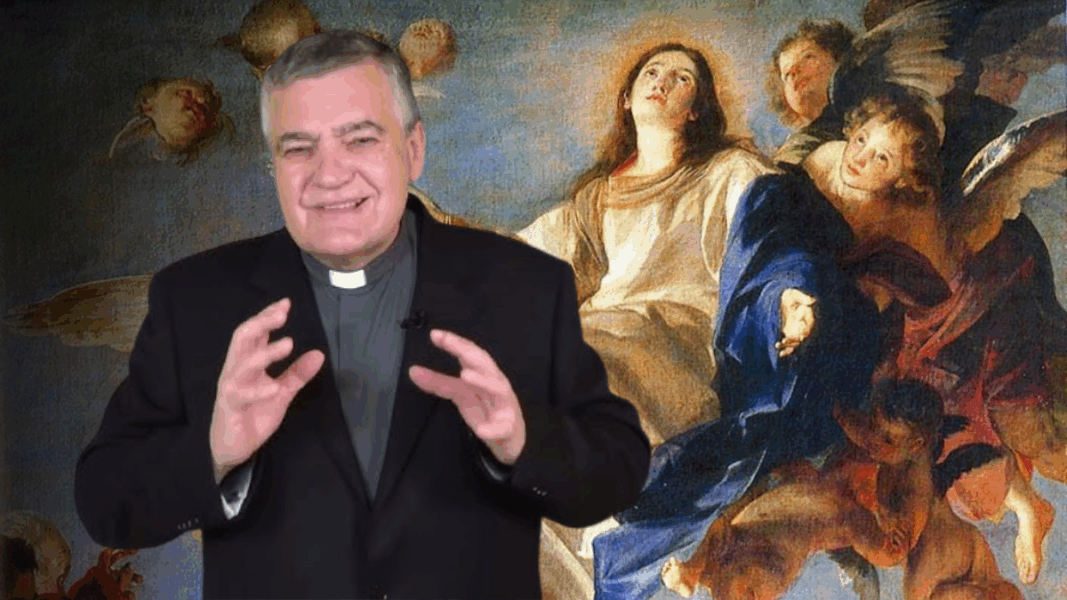
The Spanish priest Santiago Martín, founder of the Franciscans of Mary, has reacted firmly to the recent note Mater Populi Fidelis, published by the Dicastery for the Doctrine of the Faith, which discourages the use of the title Co-Redemptrix for the Virgin Mary and recommends limiting the title Mediatrix of All Graces. In a commentary titled Why Do They Say That Mary Is Not Co-Redemptrix?, the priest warns of the strong discomfort that the decision has generated among the most devout faithful of the Most Holy Virgin.
Martín compares the impact of this note to that caused by the controversial document Fiducia Supplicans, pointing out that, on this occasion, the blow has fallen directly on the Marian love of the Catholic people. He recalls that it was Benedict XVI who, without denying the titles, considered that it was not the moment to define them dogmatically, unlike the current decision to publish a restrictive note.
The priest raises a series of questions that deserve reflection within the Church. First, he wonders who benefits or is harmed by the note, warning that its publication “was not urgent” and that it has caused bewilderment among the faithful most attached to tradition. “Was it taken into account that the anger would be directed against the Pope or against Cardinal Fernández?”, he questions, pointing out that the document has provoked an unnecessary fracture among the most Marian Catholics.
The Ecumenical Argument Under Scrutiny
Another of the points he analyzes is the ecumenical argument. The document argues that Marian titles could hinder dialogue with other Christian confessions, but Martín counters that it is precisely the Anglicans and other communities that have moved away from communion with Rome. He also recalls that recent Vatican decisions—such as Fiducia Supplicans—were the ones that broke dialogue with the Orthodox. “Is ecumenism a reason or an excuse?”, the priest wonders.
“Dogmas Are Born from Theological Struggle, Not from Silence”
The founder of the Franciscans of Mary rejects the idea that the titles of Co-Redemptrix and Mediatrix create confusion. He emphasizes that all dogmas of faith were proclaimed after long theological debates and controversies. “Is it now intended to turn into a new dogma of faith that Mary is not co-redemptrix?”, he asks. He recalls that the dogmas of the Immaculate Conception and of the Assumption were also preceded by intense discussions, and that their proclamation did not close devotion, but strengthened it.
Martín cites the Epistle to the Colossians (1:24), where St. Paul states “complete in my flesh what is lacking in the afflictions of Christ,” to point out that human cooperation in redemption does not contradict Christian faith, but illuminates it. In his view, suffering offered has value before God, and the example of Mary, united to the sacrifice of her Son, reveals the deepest meaning of co-redemption.
Pastoral and Spiritual Value of the Title “Co-Redemptrix”
The priest recalls that Marian dogmas not only proclaim truths of faith, but also teach spiritual lessons. Saying that Mary is co-redemptrix—understood as collaborator in redemption—also has a pastoral value, because it teaches that human suffering, when united to that of Christ, can redeem and give meaning to the cross of each day.
For this reason, he evokes the words and teachings of St. John Paul II, who called Mary “co-redemptrix” on several occasions, to highlight the spiritual value of offered pain. “The poor, the sick, the elderly, the persecuted: all can collaborate with Christ by offering their cross,” he explains, lamenting that the Vatican has lost the opportunity to recall this fundamental teaching.
Finally, Fr. Santiago Martín considers that the faith of the people of God will not change because of what a doctrinal note says. “The faithful will continue to turn to the Virgin to ask for her intercession, because grace comes from God, but Mary intercedes as mother and mediatrix,” he affirms. And he concludes by asking for prayer “for peace in the Church and unity in the faith,” invoking the Virgin “as collaborator in redemption, co-redemptrix in the deepest sense of love united to the cross.”