


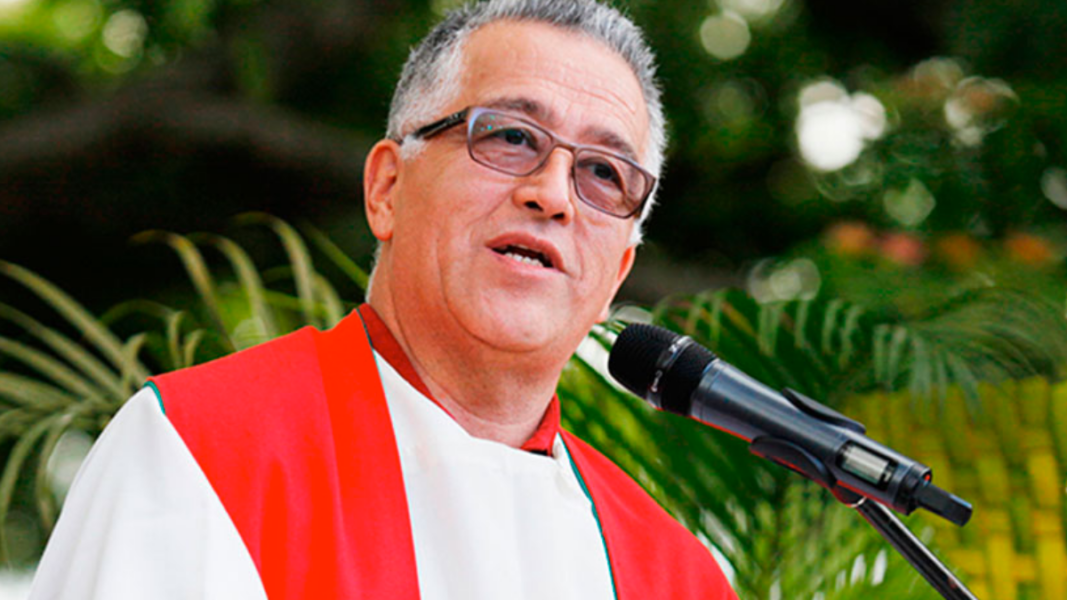
The Venezuelan crisis continues to generate unexpected protagonists. And one of them is a Jesuit priest: Father Numa Molina, 68 years old, whose closeness to President Nicolás Maduro has ignited an open conflict with the country’s Catholic hierarchy. In an analysis presented by National Catholic Register, it is evident that, while Venezuela suffers an economic and social devastation that worsens over time, Molina has become a key figure within the leader’s power circle, acting as an advisor, celebrant of private masses, and fervent defender of a regime accused of repression, corruption, and systematic abuses.
A country in tension and a priest at the heart of power
The relationship between the United States and Venezuela is going through one of its most delicate moments after several American naval attacks in the Caribbean that, since September, have left more than 80 dead. Washington insists that these are anti-drug operations, but Catholic leaders in the US have publicly denounced the alleged harm to civilians.
In this environment, Maduro—after twelve years of hyperinflation, mass exodus, institutional collapse, and allegations of human rights violations—still believes it is possible to remain in power. Trump has hinted at new military actions, and Pope Leo XIV has confirmed that the Holy See, along with the country’s bishops, is trying to reduce tensions.
And in the midst of this geopolitical game emerges a Jesuit who enjoys direct access to the president.
Numa Molina, the priest Chávez called a “prophet”
Son of poor peasants, he told the New York Times that his socialist vision was born after his mother’s death from childbirth complications due to the lack of medical services. His radio programs on the link between Christianity and socialism caught the attention of then-President Hugo Chávez, who made him a close figure and—even according to the priest himself—his spiritual director. It was there, in the intimate circle of the Bolivarian leader, that Molina met the then-Foreign Minister Nicolás Maduro.
Since then, his influence has only grown.
Molina, who claims to have visited the Vatican and spoken “at length” with the late Pope Francis about Venezuelan politics, maintains a very active public profile. He travels the country offering help to poor communities, hosts a weekly television program, and has a constant presence on social media.
Presidential advisor and celebrant of private masses
Today, Maduro calls him frequently for spiritual advice. Molina celebrates private masses for the president’s family and advises Maduro’s son, the parliamentarian Nicolás Maduro Guerra, in his contacts with Catholic communities.
This is an unusual level of political and spiritual proximity for any priest, and even more so in a country where the Church suffers persecution, surveillance, and harassment from the State’s security forces.
A priest at odds with Venezuela’s bishops
In recent months, Molina has repeatedly denounced the possibility of a US invasion, accusing the opposition—represented by leader María Corina Machado—of seeking an armed intervention to overthrow Maduro.
But his open defense of the regime has placed him in direct opposition to the Venezuelan bishops. The New York Times notes that the Church is “the last national institution critical of Maduro’s autocratic government.” The Episcopal Conference denounced the president’s reelection as fraudulent, has condemned political persecution and extrajudicial killings, and has raised its voice in defense of the poor as misery intensifies.
In response, Molina has publicly accused the bishops of being “pastors who have forgotten the Gospel and have sided with violence.” He has also pointed to them as detached from the poor, even as the country goes through one of the most serious humanitarian crises in its history.
The contrast could not be more revealing: while the bishops denounce the regime, Molina justifies it and defends it publicly.
The Society of Jesus also distances itself
The Jesuit’s stance contrasts with that of the superior general of the Society of Jesus, the Venezuelan Father Arturo Sosa, who has questioned Chavismo, described Maduro as a dictator, and called for a change in political leadership. Molina’s alignment with the regime thus becomes an additional source of tension within his own religious order.
Liberation, Marxism, and power
Another element fueling the controversy is Molina’s explicit defense of liberation theology, a current that in some of its developments incorporated Marxist elements and promoted revolutionary visions of Christ. The Holy See, in two documents from the 1980s signed by then-Cardinal Ratzinger, recognized the value of the struggle against injustice but condemned the currents that adopted Marxist methods.
The priest claims to have helped around 3,000 people financially and to run soup kitchens that serve 1,400 lunches daily. He also says he has secured a hospital for his community. But some Venezuelan priests—in private conversations cited by The New York Times—warn that his deep political involvement has entailed moral concessions in the face of a government accused of torture and drug trafficking.
A key figure within the presidential circle
Despite the controversy, one thing is clear: Father Numa Molina enjoys the trust of the Venezuelan president. In the words of a legislator from the ruling party, he is “a figure of authority… a fundamental part of the presidency of the republic.”
As the maneuvers between Maduro and Trump continue, the presence of this Jesuit priest—admired by the regime and questioned by the Church—adds complexity to a scenario already marked by humanitarian crisis, diplomatic tensions, and internal fracture in Venezuelan Catholicism.