


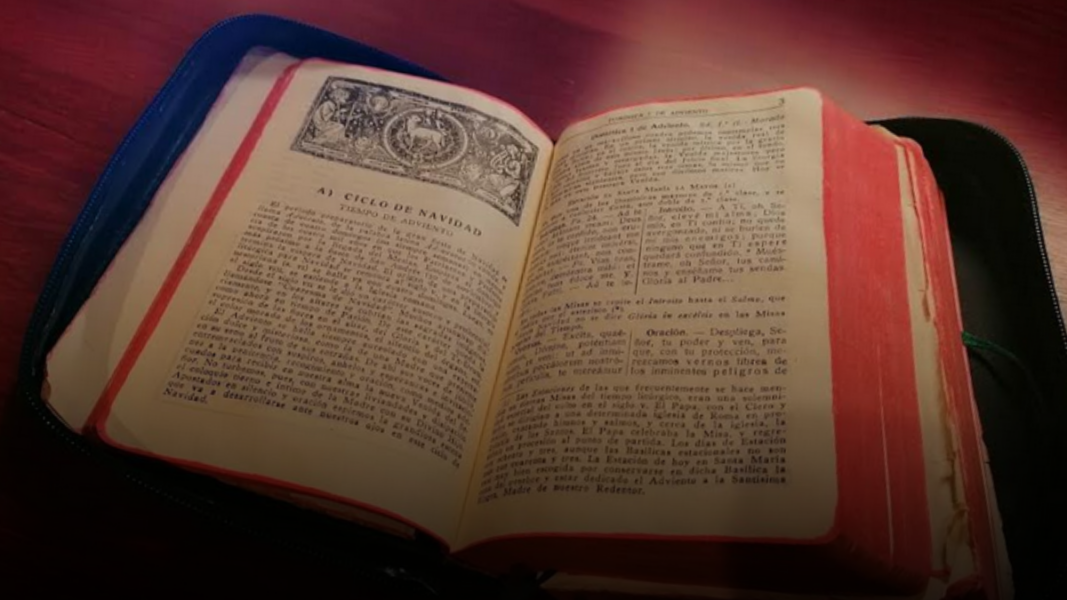
This is how the 1947 missal presents the Advent season: “The preparatory period for the great feast of Christmas is called Advent, from the Latin word Ad-ventus = coming, and it consists of four Sundays (not always weeks) in memory of the four thousand years in which the Patriarchs and Prophets sighed for the arrival of the Messiah. It begins on the Sunday closest to the feast of St. Andrew (November 30) and ends on Christmas Eve. The origin of a liturgical preparation for Christmas dates back to the 5th century, and in the Nestorian liturgy (6th century) it already has four Sundays. Then, in the 8th century, it spreads to the Roman Church.
From the 7th century, it was given an austere and penitential character, being called “Christmas Lent”. Many fasted daily, and the sacred images on the altars were covered, as now in Passiontide. From this character remains the suppression of flowers on the altar, of the Gloria and the Te Deum, the purple color of the vestments, the silence of the organ, etc.
Advent is always haloed with a sweet and mysterious expectation, like that of a Mother who senses in her womb the fruit of her womb. Hence its voices of joy, intermingled with sighs, longings and hopes and invitations to penance, recollection and prayer, as appropriate means to receive in our soul the new Coming of the Lord. Let us not disturb, therefore, with our frivolities and dissipation the internal colloquy of the Mother with her Divine Son. Posted in silence and prayer, let us spy the grand scene that is about to unfold before our eyes in this Christmas cycle”.
The wisdom of the Church is beautiful as well as good, because it is inspired by the Holy Spirit and developed over the centuries. How wonderful and simple it is to relive Advent with these ancient books that show us that perennial wisdom, which does not pass away, which is always current, like God and everything related to Him. More than seeking novelties and innovations, the Catholic is founded on stability and, in the face of deformations, on restoration. Matthew Plese develops in an article published in Advent 2021 these lines from the traditional missal, which will be interesting to pray in order to try to live, with the help of the Church’s tradition, an Advent that prepares our heart for the coming of the Lord.
Benedict XVI said that the Church lives from the past, in the present and toward the future, because, as Cardinal Sarah asked, what remains of the Church if it is not linked to its tradition? Is it not precious to think of the millions of Catholics who have lived Advent this way, illuminated by the wisdom of the Church? A slow development that begins in the 4th or 5th century and reaches a defined form in Rome between the 6th and 7th centuries. For three-quarters of its history, the Church militant has guided its faithful along this path, producing abundant fruits of holiness.
When Dom Prosper Guéranger wrote about the history of Advent, he expressly pointed out how “the name Advent is applied, in the Latin Church, to the period of the year during which the Church requires the faithful to prepare for the celebration of the feast of Christmas, the anniversary of the birth of Jesus Christ. The mystery of that great day had every right to be honored with preparation through prayer and works of penance”. Advent is thus a time of preparation for the birth of our Savior, through works of penance, lived through a series of ecclesiastical offices elaborated with the same purpose.
To help with this fruitful experience of Advent, Plese, in his aforementioned article, recalls some traditional liturgical and domestic customs of Advent that he recommends recovering. Not out of nostalgia, but out of fidelity to the perennial teaching of the Church, because, “in a society that rushes to celebrate Christmas and obscures all penance and preparation, maintaining these customs will help us preserve true Catholic practices, allowing us to do the appropriate penance now, before celebrating from December 25 until February 2”.
The Church teaches that liturgical prayer is superior to personal prayer, hence the importance of frequent attendance at Mass and of praying the Word proclaimed in the Mass during this strong time of Advent, according to the ancient practice of Lectio Divina. And to be attentive to pray with a true treasure: the O Antiphons, a series of antiphons to the Magnificat that are prayed as part of Vespers (evening prayer) from December 17 to 23, inclusive. Each of the titles of the O Antiphons addresses Jesus with a special title given to the Messiah and refers to a prophecy of the prophet Isaiah. It is unknown when the O Antiphons began, however, they are already mentioned in the 4th century A.D..
As a penitential time that it is, fasting and abstinence are important in Advent. In this regard, totally forgotten in the current Church, Matthew Plese explains in another article how “the Catechism of the Liturgy describes the fast before Christmas: ‘In a passage from the History of the Franks by St. Gregory of Tours, we find that St. Perpetuus, one of his predecessors in the see, had decreed in the year 480 A.D. that the faithful should fast three times a week (Monday, Wednesday, and Friday) from the feast of St. Martin (November 11) until Christmas… This period was called St. Martin’s Lent and its feast was celebrated with the same type of joy as Carnival.’ According to historical records, Advent was originally called Quadragesimal Sancti Martini (Forty Days’ Lent of St. Martin). Also the consumption of meat was prohibited every day during Advent”. With ups and downs, the practice spread throughout European Christendom over time, sometimes forgotten, and others, restored. In the time of St. Charles Borromeo, for example, in the 16th century, the saint urged the faithful under his care in Milan to observe fasting and abstinence on Mondays, Wednesdays, and Fridays of Advent.
Even closer to our modern times, vestiges of St. Martin’s Lent remained in the Roman Rite during the 19th century, when in some countries fasting was still imposed on Wednesdays and Fridays of Advent.
In the United States, fasting on Wednesdays and Fridays of Advent was maintained, as was the universal practice of the Church, until 1840, when the Wednesday fast of Advent was abrogated for Americans. The Friday fast of Advent was abrogated in 1917 in the United States and abroad with the promulgation of the 1917 Code of Canon Law. The Code also eliminated Advent Wednesdays for all localities that still required them, as well as Advent Saturdays that were maintained in other places, such as in Italy.
But even the attempts to maintain elements of the Advent fast between the 17th and 20th centuries were shadows of St. Martin’s Lent. In fact, the Church continued to encourage people to maintain the venerable discipline of St. Martin’s Lent, even if it was not obligatory under pain of sin. This fact is expressed with conviction in the Catechism of Perseverance:
“The Church neglects no means to rekindle in her children the fervor of their ancestors. Is it not just? Is the little Child we await any less beautiful, less holy, less worthy of our love now than before? Has He ceased to be the Friend of pure hearts? Is His coming to our souls any less necessary? Alas! Perhaps we have raised there all the idols that, eighteen centuries ago, He came to overthrow. Let us therefore be wiser. Let us enter into the perspective of the Church: let us consider how this tender mother redoubles her solicitude to form in us those dispositions of penance and charity that are necessary for a proper reception of the Child of Bethlehem”.
Today, the West has definitively forgotten its Advent fast, Plese asserts: “The Advent fast, observed for a long time in anticipation of the birth of Our Lord, had ceased, although the fasts of the Advent Ember Days, the Vigil of the Immaculate Conception, and Christmas Eve were maintained. However, at the time of the Second Vatican Council, even these venerable fasts were suppressed”. Despite being one of the holiest days of the year, Christmas had ceased to be prepared with any kind of fast. And shortly afterward, the secular world, insisting on materialism, turned Advent into Christmas. Christmas parties, gift exchanges, and excessive consumer spending have taken place during the time when our ancestors diligently prepared for the birth of the Redeemer by observing a fast. How far we have strayed from the times of St. Martin!”
That is why Plese recommends, “above all, as we approach this year’s Advent and await the celebration of the Nativity of Christ, let us embrace the fast”. Fasting on Wednesdays and Fridays during this time is preferable to not fasting at all, although this mitigated fast is only a vestige of the true Advent fast. Strive to maintain at least Mondays, Wednesdays, and Fridays from St. Martin’s day as fasting days. If they wish to do more, keep the forty days as fasting days. In fact, as St. Francis de Sales pointed out: “If you are able to fast, you will do well to observe some days beyond those ordered by the Church.” Tuesdays, Thursdays, and Saturdays would be appropriate to observe as days of abstinence without fasting. Saturdays are, separately, an appropriate day to fast in honor of Our Lady.”
Plese also points out the importance of maintaining the fast on the Vigil of the Immaculate Conception – applicable for those who live liturgically according to the 1962 Missal, in which the Vigil is a proper day, and not merely an evening Mass and a time of nighttime adoration – and the Ember Days must continue to be observed. It is important to pause for a moment to address the Ember Days. Plese notes that, “although the observance of Ember Days is no longer mentioned in mainstream Catholicism after the changes introduced in the 1960s regarding fasting, the faithful can, and should, continue to observe them. The Ember Days are set aside to pray and give thanks for a good harvest and God’s blessings. If you are in good health, fast on the Wednesday, Friday, and Saturday immediately following the feast of St. Lucy, December 13”.
There was also traditionally fasting on the last day of Advent, Christmas Eve; fasting for those aged 21 to 60 and abstinence (for those over 7 years old), following the traditional requirements. “Christmas Eve has been a vigil of fasting and abstinence for centuries” – says Plese, and continues: Unfortunately, this vigil ceased to be a day of fasting in the modern Catholic Church after the changes of 1966. However, traditional Catholics continue to maintain this day as a day of fasting and abstinence, just as our ancestors in the faith did for centuries. Nevertheless, with a single exception, the Church has allowed for centuries a double collation on this particular day of fast, because it is an ‘joyful fast.’ This underscores the feelings of joy that should permeate the Catholic home on this last day of Advent”.
It is paradoxical today to see neoconservative tele-preachers (also known as “digital missionaries”) announcing innovative methodologies for living Advent, all uprooted from tradition, imported from the world and Protestant emotionalism. I wonder, however young they may be, how they do not ask themselves if it would not be more judicious and prudent to live this liturgical season with the proven tools that the Church has provided to its children for centuries; and why no authority in the Church practices with them the important work of mercy of teaching them what they do not know, instead of looking the other way and allowing the blind to lead the blind, toward the precipice. Glorifying God as He wishes and the salvation of souls are at stake.
Note: Articles published as Tribune express exclusively the opinion of their authors and do not necessarily represent the editorial line of Infovaticana, which offers this space as a forum for reflection and dialogue.