


By Dominic V. Cassella
At the beginning of our marriage, my wife and I were determined to establish an environment of faith in the home for our children. We wanted each day to be centered on Jesus Christ, for the week to begin with the celebration of the Liturgy, and for the year to be marked by the traditional feasts and fasts of the Catholic Church.
Beyond the common feasts of Easter and Christmas, or the major fasts of Lent and Fridays, we decided to try to follow some of the lesser-known fasting seasons. One such season is the period preceding Christmas, called in the Eastern Christian tradition the Fast of St. Philip.
Instead of listening to Christmas music immediately after Thanksgiving, we would focus on music that is clearly anticipatory: Advent hymns. We would abstain from meat and sweets, saving them for Christmas Day and its season. Instead of an early “Christmas season” before Christmas even began, Advent would be there to sharpen our desire for the coming of Christ.
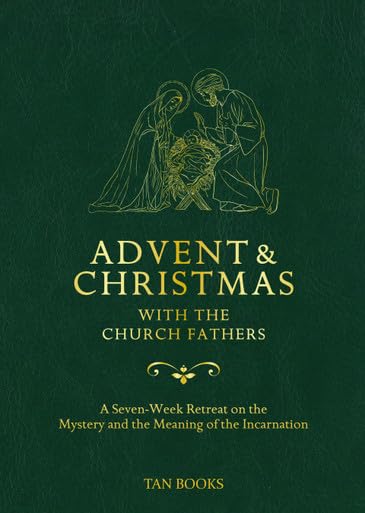
Advent and Christmas with the Church Fathers, TAN Books’ new seven-week self-directed retreat, begins with that principle in mind.
Unlike other devotionals I have used, Advent and Christmas with the Church Fathers does not lead you by the hand day by day. Instead, it is a seven-week theological retreat that guides the reader to meditate on the mystery of the Incarnation. Each week is filled with selections from the prayers, commentaries, and poems of authors from the Greek, Latin, and Syriac traditions, as well as from Sacred Scripture, the Catechism of the Catholic Church, and the Holy Mass. And the weeks are punctuated with various questions for meditation.
The book begins with the first week of Advent on the Roman calendar and concludes with the Feast of the Presentation of the Lord, in early February. The first week of the retreat invites one to consider the virtue of hope. Through hope, we trust in attaining what we long for. It is a gift from God to hope in eternal life and eternal joy: not just to be optimistic, but expectant of success and the full joy of the splendor of God.
In fact, beginning with hope is always timely as we live in this world of losses and gains. The foundation of this hope is that we, as Christians, have been made co-heirs of the Kingdom, citizens “who are not of this world.” And, consequently, we are strangers—like foreigners in a strange land—on the way to the Kingdom of Heaven, to which we have an authentic right through Christ. If anyone is to undertake such a journey, the hope of arriving is necessary even before taking the first step.
To ignite this hope, Advent and Christmas, with its selections from the Fathers and its meditative questions, helps the reader to pray with the best teachers and guides of the Church, those who have already made the journey and now intercede for us from the other side.
The work is clearly aware of the coherent vision of the Christian year as a living participation in the Christian mysteries. A quote from Virgil Michel advises us to think of the liturgical cycle as the divine sacrifice that is repeated daily in the Church: “As we cannot exhaust our capacity for the divine in one day or one year, the Church of Christ, with the infinite patience and tender love of its divine Founder, continues to present us with the divine means to live Christ, thus truly fulfilling its mission of achieving the ever greater fullness of the Redeemer.”
The second, third, and fourth weeks of Advent are dedicated to Peace, Joy, and Love, respectively, adapting the first triad of the twelve fruits of the Holy Spirit (Gal 5:22-23).
Reflecting on Peace, the text evokes the patience and endurance necessary in this life. By recalling that we celebrate the Immaculate Conception during this second week of Advent, the book reminds its readers of Mary as a model and encourages drawing closer to Christ through Mary’s maternal love.
The third week of Advent, which begins with Gaudete Sunday, is a time of joy, and the book invites the reader to consider what “joy” is. By meditating with the Fathers and Doctors of the Church, we see that joy is the fruit of love, the virtue dedicated to the fourth week.
After weeks dedicated to Hope, Peace, Joy, and Love, we arrive at Christmastime and the experience of the cause of those virtues on which we have spent the last four weeks reflecting. But the devotional does not end on Christmas Day. Instead, the text could be divided into two parts: the Fast and the Feast.
One of the greatest strengths of Advent and Christmas with the Church Fathers is that it does not stop at the singular day of Christmas. Instead of making a book that ends on a single day, TAN has created a retreat that does not consider Christmas as the final goal. By inviting the reader to continue praying throughout the festive season, the devotional becomes a true aid to the liturgical rhythm of the Church.
It is easy to begin Christmas with the opening of gifts. All too often, however, the season is discarded along with the wrapping paper. But in the Gospel of St. John we read that the “Word became flesh and dwelt among us” (Jn 1:14). The celebrations immediately following Christmas—which direct our minds to Mary, the arrival of the Magi, the Circumcision, and the presentation in the Temple—manifest this “dwelling.”
Advent and Christmas with the Church Fathers leads us to be that dwelling for Christ, helping the reader to turn Christmas and its time of preparation into the beginning of a deeper life with Christ.
Dominic V. Cassella is a husband, father, and doctoral student at The Catholic University of America. He is also an editorial and digital assistant at The Catholic Thing.