


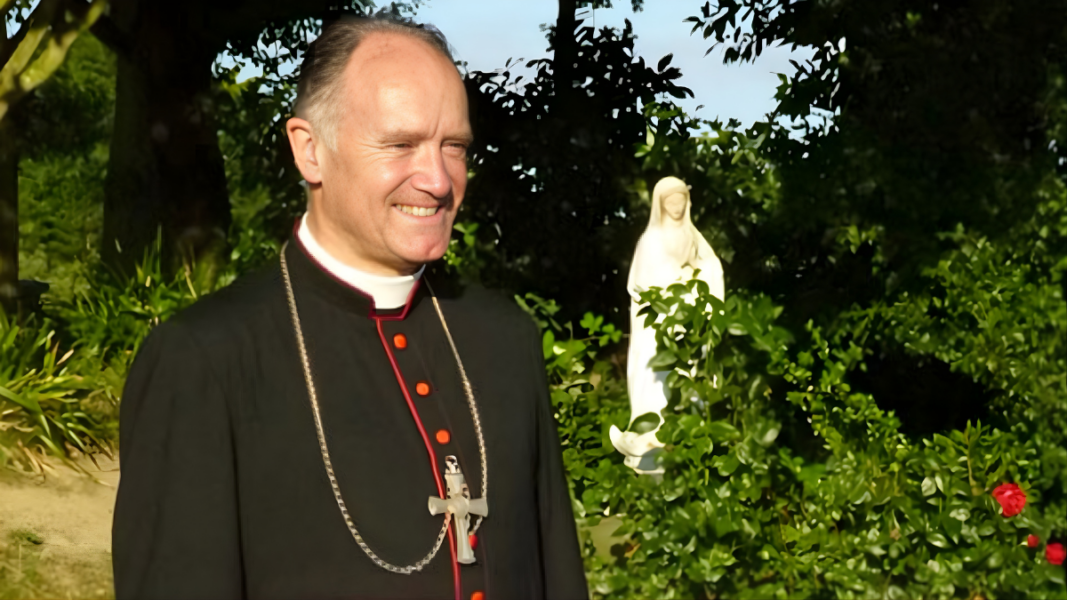
Bishop Bernard Fellay, who was Superior General of the Priestly Fraternity of Saint Pius X (FSSPX) from 1994 to 2018, granted an extensive interview to Immaculata TV (Kenya) on November 23 last year, in the context of a pastoral visit in which he administered the sacrament of Confirmation to more than seventy faithful. In his intervention, he addressed the profound meaning of Confirmation, the spiritual situation of the world, the future of the FSSPX in Africa, and the recent controversy surrounding the Vatican document Mater Populi Fidelis.
A document that “downgrades” the role of the Virgin
Fellay described the document with words unusual in ecclesiastical language. In his view, the text not only suffers from doctrinal poverty, but is offensive to the figure of the Mother of God. He went so far as to say that it is a “lamentable” document and even “an insult to God and His Mother,” showing his concern for a trend that, according to him, unjustifiably minimizes Mary’s role in the history of salvation.
The bishop explained that the Vatican’s objection to these titles stems, more than from serious theological reflection, from a misguided ecumenical will. He pointed out that in some ecclesiastical circles the slogan is repeated that “only Jesus is enough,” a formula that, Fellay observed, coincides with the Protestant approach. For him, this logic inevitably leads to diminishing the Virgin and breaking with the traditional Catholic understanding of human cooperation with grace.
“Since the Council, there has been a Protestant spirit in the Church. That is why it is repeated: ‘only Jesus.’ But the Church has always taught that the Virgin has an essential role in salvation”.
A solid theological tradition that cannot be ignored
Far from being a secondary piety or a mere devotional development, Fellay recalled that the titles of Co-Redemptrix and Mediatrix have been mentioned by numerous Popes and theologians since the late 19th century. Although they were never defined as dogma, they do form part of a continuous current of the ordinary magisterium.
The prelate emphasized that Mary’s cooperation in the Redemption is already hinted at in Genesis itself, when God announces that the Woman will crush the serpent’s head. From this starting point, he explained, it is understood that the Virgin participates in a singular way in Christ’s work, not as a rival, but as an instrument desired by God.
“God wants His creatures to cooperate with Him. He does not exclude human freedom: He perfects it. And salvation is the greatest fruit of that cooperation”.
According to Fellay, the contemporary rejection of these titles does not arise from deeper biblical reflection, but from doctrinal discomfort derived from the desire not to offend other Christian confessions. This approach, he affirmed, ends up disfiguring the Catholic tradition.
“We will continue to use these titles”: reaffirmation in the face of confusion
Despite the official stance, Fellay affirmed that the Priestly Fraternity of Saint Pius X will not modify its Marian teaching. He considers the titles of Mediatrix and Co-Redemptrix not only legitimate, but especially necessary in a time of ecclesial crisis. Doctrinal clarity, he insisted, cannot be sacrificed in the name of pastoral strategies that have shown no fruit for decades.
“They are titles more timely than ever. The Church is not built on ambiguities, but on clear truths”.
Fellay suggested that renouncing these expressions weakens catechesis and deprives the faithful of a richer understanding of Mary’s spiritual mission.
Marian devotion, key to guiding the faithful
In the same vein, the bishop highlighted that the pastoral response to doctrinal confusion does not consist in “downgrading” Mariology, but in strengthening it. He recalled the message of the Miraculous Medal, where the Virgin taught that many graces do not reach the faithful simply because they are not asked for. Fellay paraphrased this teaching to emphasize that the solution to the crisis is not in speaking less about the Virgin, but in turning to her more.
“The relationship with the Virgin should be like that of a child with his mother. God wants this devotion; following it is following His will”.
A symptom of the post-conciliar crisis
For Fellay, Mater Populi Fidelis is not an isolated phenomenon, but another chapter in a process of doctrinal weakening that, according to him, has affected the Church since the Second Vatican Council. He pointed out that many ecclesial realities have suffered alarming deterioration: faith, vocations, the Church’s moral influence in the world. In that context, he sees in the Marian document another step in the renunciation of traditional Catholic identity.
The bishop lamented that, instead of reaffirming doctrine, much of the Church opts for ecumenical strategies that, in his opinion, have shown their pastoral sterility.
A call to defend Marian doctrine without timidity
The interview concludes with a firm call not to yield in the defense of tradition. For Fellay, the Church cannot renounce the richness of its Mariology without losing an essential part of its identity. In that line, he affirmed that the Fraternity will continue to teach what the Church has always taught, regardless of the doctrinal winds of the moment.
“Trying to cast a shadow over the Virgin is going against God’s will. The Church has already spoken: we will continue”.