


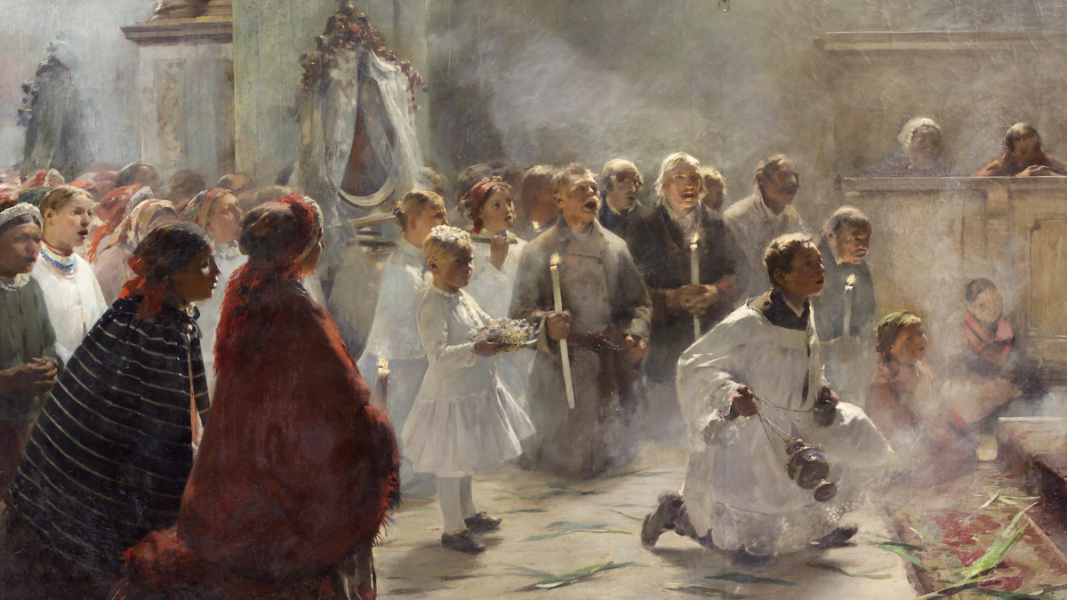
After the penitential preparation of the prayers at the foot of the altar, the traditional liturgy introduces us to a movement of praise that elevates the soul towards God. The rite of incense, deeply symbolic, opens this new stage of the Mass, in which the inner sacrifice of the believer is united to the sacrifice of the altar. This chapter of Claves — FSSP delves into the spiritual meaning of the incensations, their relationship with divine worship and the role of the Introit, the ancient prayer that marked the true entry into the celebration.
Incense: symbol of sacrifice and offering
Once the initial prayers are concluded, the priest performs one of the most expressive gestures of the entire liturgy: the lighting of the incense. Curiously, in the first centuries, Christians avoided its use to distinguish themselves from pagan rituals that employed it abundantly. However, incense, already present in the ceremonies of the Old Testament, found its natural place in Christian worship over time. Its meaning is deeply united to sacrifice: the same Greek word from which “thuriferario” derives comes from the verb thúein, “to sacrifice”. That is why the first Christians refused to burn incense before idols or emperors: sacrifice belongs solely to God.
The grain of incense, completely consumed by the fire, expresses the total surrender of the soul that offers itself to the Lord. The column of perfumed smoke that rises symbolizes the oblation that ascends towards heaven; for this reason, during the Offertory, the faithful are also incensed, called to unite themselves spiritually to the sacrifice of Christ. At the same time, incense purifies: just as in the Old Covenant Aaron consecrated the tent of meeting and the ark, incense sanctifies the altar today and those who will participate in the mystery. This is the reason why the priest blesses it before using it, asking that it be sanctified by Him in whose honor it will be burned. The only exception occurs when the Most Holy Sacrament is exposed: then it is not blessed, because it is no longer a matter of purifying but of adoring.
The priest first incenses the altar cross, with three double swings, a gesture reserved for Christ and, by extension, for the Most Holy Sacrament. If there are relics on the altar, they are also venerated with incense in homage to the martyrs. Then the altar itself is incensed following a precise rite, and finally the priest, who in the Mass acts in persona Christi, sacramentally representing the Lord.
The Introit: the true entry into the Mass
After the incensations, the priest takes his place on the Epistle side and reads the Introit, whose name comes precisely from the idea of “entry”. In its origins, this prayer marked the formal beginning of the Mass and was sung during the procession that led from the sacristy to the sanctuary, accompanied by a complete psalm of which today we only preserve a fragment.
The Introit is an interpretive key to the liturgy of the day. Its texts, often of great poetic beauty, express the fundamental idea of the feast or liturgical season. Some are so characteristic that they have given names to entire Masses: the Gaudete, the Lætare, the Quasimodo, the Rorate Mass or the Requiem, each beginning with the word that identifies the celebration. Listening to the Introit attentively allows one to enter better into the spirit of the mystery that the Church celebrates.
The doxology Gloria Patri: the Church’s Trinitarian response
The Introit concludes with the doxology Gloria Patri, the brief and solemn praise that honors the Most Holy Trinity: “Glory to the Father, and to the Son, and to the Holy Spirit…”. This prayer, very well known to the faithful, closes all the psalms of the Divine Office and is also prayed in the Rosary. Its origin is Eastern and is marked by the doctrinal context of the centuries in which the Church combated Arianism, the heresy that denied the divinity of the Son. In the face of this deviation, the Gloria Patri explicitly proclaims the equality of the three Divine Persons, and its conclusion—“as it was in the beginning, is now, and ever shall be, world without end”—affirms the eternity of the Son against those who considered Him inferior to the Father. Already in the sixth century, the Synod of Vaison emphasized the importance of this formula as a defense of the Catholic faith.
In the liturgy, the doxology manifests that the prayer of the Old Testament—the psalms—reaches its fullness in the New, where the revelation of the Trinity shines with full light. Thus, each Introit ends by directing the prayer towards the glory of the One and Triune God, which is the ultimate end of the entire Mass.