


By Fr. Paul D. Scalia
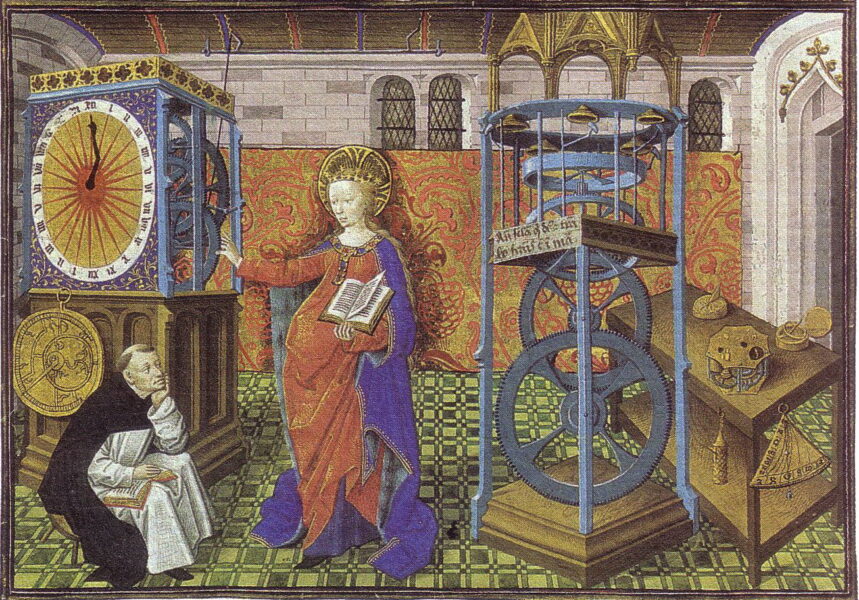
In the 12th and 13th centuries, monks developed some of the first fully mechanical clocks. Their purpose was simple. The monks went to the chapel seven times a day to sing the praises of God and intercede for the world. The clocks allowed them to do so in a more precise, disciplined, and uniform manner. With these time instruments, they could, in effect, master time and put it better at the service and praise of God.
Now, let us consider what the clock has become and how we treat time. For the monks, time was given to God: in work, study, rest, and prayer. For us, it is commercial and worldly. We punch the clock, we bill by the hour. We hate to have our time wasted, because time is money. But we do not mind killing time ourselves.
The monks developed clocks to consecrate time to God in a more deliberate way. They understood that time has meaning because of eternity, because the Eternal One has entrusted it to us to administer and care for it, for His glory and our sanctification.
We, with the most advanced clocks, chronometers, and timers, have excluded God from time. The result is not surprising. As happens with every created reality, once time is torn from the purpose of its Creator, it becomes either a god that devours us or a slave that we abuse. Thus we find ourselves either enslaved to the clock or killing time.
The Advent season that begins today deals precisely with time. It gives us the opportunity to consider how we see and use it. “You know the time,” says St. Paul (Rom 13:11). Well, perhaps we know what time it is, but we do not really know what time is.
Advent points us to a future time. It looks toward the coming of the Lord. That is why all the readings have, not the Christmas tone that many expect after Thanksgiving, but a warning about the end of the world and the Second Coming of Christ. In this sense, the Catholic Church is the most future-oriented institution in the world: it looks to the most remote future, the end of the world.
“Therefore, stay awake! For you do not know on which day your Lord will come” (Mt 24:42). That is a sobering command. The Church’s vision of the future is not the progressive arc of history bending toward justice. There is no inevitable improvement in human goodness or virtue. On the contrary, the Church sees that the state of the world worsens as the coming of the Lord approaches.
Paradoxically, Advent prepares us for that terrible moment in the future by recalling the warmest and most beautiful moment in the past: the Incarnation. His glorious coming is nothing but the consummation of what He accomplished in His first coming. If we prepare well for His birth—if “we behave properly as in the day, not in reveling and drunkenness, not in debauchery and lust, not in rivalry and jealousy” (Rom 13:13)—then we will be able to stand firm at His second coming.
This happens now. In the present, the past and the future meet, and they take on meaning. Now, in the present moment, we remember God’s works in the past to prepare for His future coming.
This also explains the Church’s liturgical year, which begins today. Yes, the Church still observes the civil year that begins on January 1, and the Vatican even has a fiscal year. But the Church does not really measure time according to the world or the market. It measures it according to its Liturgy: by its annual journey with the Lord through His life.
From today, the Church undertakes its annual remembrance of the life of Jesus: preparing for His birth and celebrating it; contemplating His life, His preaching, and His miracles; and, above all, accompanying Him in His Passion, death, Resurrection, Ascension, and gift of the Holy Spirit.
Time is given to us for this purpose: to know Jesus Christ more intimately and to conform our thoughts, words, and actions ever more to His. And since on this side of Heaven we will never do it perfectly, we commit again to trying anew, year after year.
Time is not money. It is much more important than that. It is God’s gift so that we may know Him better. It is the opportunity to repent: to leave sin in the past and cultivate virtue. It is the opportunity to forgive: to leave behind resentments and grudges and bring charity into the future. It is the opportunity to grow in grace: to increase in our knowledge and love of Jesus Christ and our commitment to Him. If we do not use time for this purpose, then we are wasting it.
The clock began in a monastery and ended up on a time sheet. But we can reverse this. We can use our time—and all our devices to measure it—not only for worldly purposes, but for God. We have alarms, timers, and reminders on all our devices. They remind us of appointments, anniversaries, tasks, etc. We could also use them to remember to pray, read Scripture, celebrate a feast, or go to confession, and so on.
The beginning of Advent is a call to be good stewards of time, neither worshiping it nor abusing it, but putting it at the service of His glory and our good.
About the author:
Fr. Paul Scalia is a priest of the Diocese of Arlington (VA), where he serves as Episcopal Vicar for the Clergy and pastor of Saint James in Falls Church. He is the author of That Nothing May Be Lost: Reflections on Catholic Doctrine and Devotion and editor of Sermons in Times of Crisis: Twelve Homilies to Stir Your Soul.