


We’ve read these days that the Spanish Episcopal Conference has decided to award singer-songwriter Rosalía and writer Javier Cercas with the “Bravo” awards , which are supposed to represent “a recognition for service to human dignity and evangelical values in the field of communication”.
Well, as far as I know, Cercas has explained that his award-winning book, “El loco de Dios en el fin del mundo”, came about after the Vatican contacted him to accompany a trip to Asia by Pope Francis, from which, of course, he returned praising how different that pope was from the Church and claiming that he had come back even more atheist and anticlerical than he already was. Rosalía, for her part, while expressing the need for God that her heart feels, presents on the back cover of her album Lux an image of herself without clothes and lying on a bed with her arms open. A phrase from the first single of this new album, which has served as an excuse for neoconservatives to talk about a “revival of the Catholic”, says textually “I´ll fuck you until you love me”. I don’t know if any member of the Spanish Episcopal Conference has bothered to listen to the lyrics of the songs, or if they were simply dazzled by the artist’s attire similar to a religious habit on the album cover, but it seems hardly evangelical and Catholic to me both the back cover and that scandalous phrase. These are just two of the awardees.
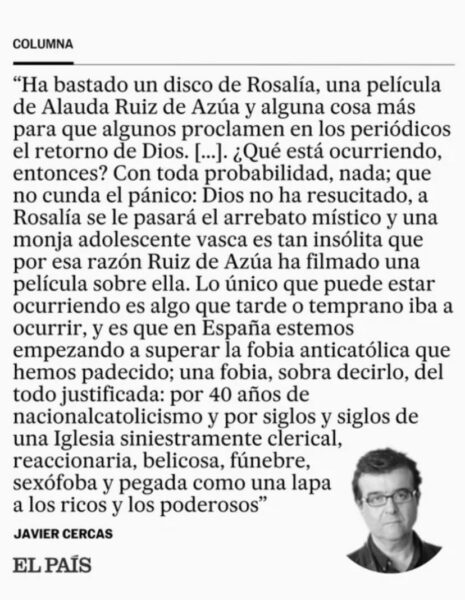
We’ll see if Rosalía shows up to receive the award, but the most standout thing in terms of the level of ridicule reached is that, in the same week she received the award from the Spanish bishops, Javier Cercas has published a column in the newspaper El País titled “Dios no ha vuelto”, refuting the Catholic revival that the episcopate and the homeland influencers are so celebrating, focusing precisely on the two planks to which the defenders of such a revival cling: Rosalía’s album and the movie “Los Domingos”. Cercas’s undeniable arguments are that “churches remain empty, seminaries and convents remain empty, and the number of Catholics is plummeting”. The writer believes that “the only thing that can be happening is something that sooner or later was going to happen, and that is that in Spain we are beginning to overcome the anti-Catholic phobia that we have suffered; a phobia, needless to say, entirely justified: by 40 years of national-Catholicism and by centuries and centuries of a sinisterly clerical, reactionary, belligerent, funereal, sexophobic Church stuck like a limpet to the rich and powerful”. Could there be a greater slap in the face, a greater sign of contempt for the bishops than this column from the awardee in the week of the award? Given how in agreement they are with this as black as it is false legend, perhaps at the CEE headquarters they don’t even get the message.
In the face of this blush-inducing farce, what I really wonder when seeing this is what the Spanish bishops are doing. Why are they increasingly dragging themselves before the world? Don’t they realize how ridiculous they look chasing fashions to which they are always late? Don’t they see that the world will despise them just the same or more? And don’t they see that they create disaffection among faithful who see that these successors of the Apostles are not defending the flock from the world and affirming them in the faith, but pushing them to be “worldly Catholics”, worldly Catholics? Don’t they see that they leave the flock entrusted to them helpless and that God will hold them very accountable for it?
I reached the state of utter perplexity in which I find myself after a situation of perplexity that was very painful. After years comfortably settled in a “lively” parish in a town in the diocese of Barcelona, I began to observe first “isolated facts” that clashed with what the Church always did and preached. The supposed isolated facts, precipitated in quantity and gravity during the pontificate of Francis, led me to realize that they were not isolated, but well geared into an alternative ecclesial discourse and practice; a Church that does not recognize itself and renounces its history and tradition. As if a new Church were being built before our eyes consciously or unconsciously, or because at minimum they have deviated in an increasingly alarming way, which disfigures the face of the Bride of Christ.
The ecclesial hierarchy has made its own the concepts of “progress” and “democracy”, so proper to modernity, and seems to have forgotten its own logic and its supernatural dimension. Ecclesial organizations like Caritas and Manos Unidas speak without qualms the language of the world and assume the counter-values of the 2030 agenda. It is difficult to distinguish in the words of the #2 of the Vatican, Cardinal and Secretary of State Pietro Parolin, whether we are dealing with a prince of the Church or a United Nations official. These are just a few examples. The problem is serious when the Church assumes not only the language, but the concepts and principles of the world.
The words of Msgr. Marcel Lefebvre in 1974 inevitably come to mind when he distinguishes between a Catholic, eternal Rome, and a Rome tending toward neomodernism and neoprotestantism.
For those whose mention of Bishop Lefebvre’s name causes a neuronal short circuit, it is worth briefly clarifying to ease their conscience that the Society of Saint Pius X that he founded is neither sedevacantist nor schismatic, as demonstrated by the fact that Benedict XVI lifted the excommunication in 2009 of the bishops ordained by Msgr. Lefebvre in 1988 and the prerogatives over the administration of sacraments that Francis granted them, as well as other good arguments that Kennedy Hall expounds in his highly recommended book “SSPX: The Defence”. I am not a Lefebvrist, but one would have to be very blind not to see the prophetic importance of Lefebvre in the chaotic decades of the 1970s and 1980s.
Returning to the doctrinal, liturgical, and moral deviations emanating from Rome, it is easy to observe how the deformation of the faith of the highest hierarchy leads to the laity. Amid the disorientation and the opportunism of those who, in troubled waters, want to be fishers of men on their own initiative, not by a call (what the Lord calls in the Gospel “hirelings”): the influencers and their new pentecostal Catholicism, including the fact that they live or intend to live economically from “evangelizing” full-time and from what their “faithful” or followers or benefactors contribute. With that absolutely infamous motto of Hakuna, which reflects this situation: “on our knees before God, man, and the world”, and the fact that, in their early statutes, they explicitly stated their adherence to the principles of the 2030 agenda. Whether it was out of naivety or ignorance does not lessen the gravity of the matter. That is the attitude toward the world of the Church that is most active today, the one that shows itself in events and social networks: that of young and not-so-young neoconservatives, blindly followed by the bishops, who think that their ability to mobilize will save the day for them.
On the day of the Immaculate Conception this same year, this week, the 60th anniversary of the closing of the Second Vatican Council is commemorated. Sixty years. How have they not yet seen that wanting to please the world and resemble it doesn’t work? That the temples have been emptied, that the administration of sacraments is at a minimum, that millions of people have lost the faith, with great responsibility in all this from those who had been entrusted with being their pastors.
It is clear that the origin of the problem is not the Second Vatican Council, we are not that naive. We know that modernism had been operating like a cancer in the Church for decades prior, and it finally seems to have left only its “shell”, inhabited by a different organism, which has taken possession of it, which has made it captive. I know nothing about biology, but I see it as something similar to a cancer that devours healthy cells but, instead of killing the being it inhabits, takes possession of it like a parasite, replacing the healthy cells it destroyed with foreign ones to that organism, but which live in it and control it, having replaced its essence with another. What the Second Vatican Council meant was that that organism that had been parasitizing the Church little by little finally conquered it and transmuted its essence. Or, at minimum, it tried. That “aggiornamento” was the worst thing that has happened to the Church throughout its two millennia of existence.
Is there a solution? Yes, of course. First of all, the conviction that the gates of hell will not prevail over the Church, as Christ promised. Although it is also true that he asked “if when the Son of Man returned, would he find faith on the earth”. In any case, the Church is led by the Lord and is in his hands.
Our calculations, plans, and ideas are just that. But I am reading these days a very interesting book by Professor Peter Kwasniewski, “Ministers of Christ”, which has a tripartite structure perfectly applicable to the situation of the Church: 1) foundation, 2) deviations, and 3) restoration, which is the only possible solution to the deformations of which the Church is a victim. As we said last week, not out of nostalgia, but because it is what must be as it forms part of the nature and essence of the Church and is therefore perennial.
Human essence does not change. And to it the Church speaks, to lead men to God. An immutable God. Therefore, the Church has a discourse beyond fashions, times, and places. A deviation is not a reform or a desirable adaptation to the circumstances of the world. That has never been the logic of the Church. And it cannot be today either.