


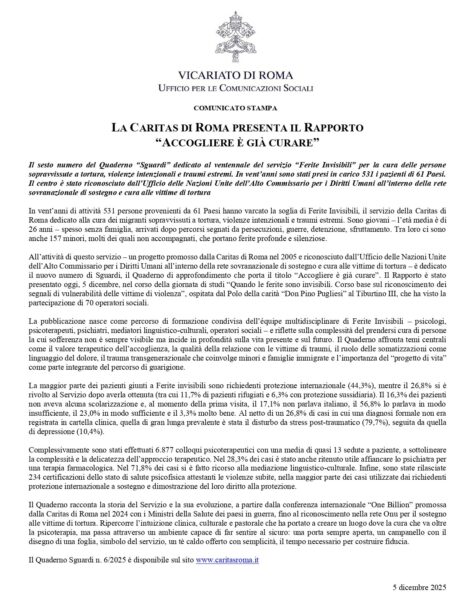
Caritas Roma has published the report “Welcoming is already healing”, dedicated to the twenty years of the service Heridas Invisibles, a program for caring for migrant survivors of torture, intentional violence, and extreme traumas. In these two decades, the center has assisted 531 people from 61 countries, establishing itself as a recognized technical reference even by the United Nations. However, the report once again shows a growing trend in certain ecclesial spheres: the almost literal adoption of the language of international organizations, which tends to displace the spiritual and evangelizing framework proper to the Church.
A valuable human work, presented from secular categories
The patients treated by Heridas Invisibles are mostly young people, with an average age of 26, many of them without family and marked by paths of persecution, war, or exploitation. Among them there are 157 minors, several unaccompanied, whose psychological wounds require prolonged accompaniment.
The service has conducted 6,877 psychotherapeutic encounters and has had to resort to linguistic-cultural mediation in more than 70% of cases. Clinically, the dominant pathology is post-traumatic stress disorder.
The human dimension of the work is unquestionable. But its official presentation is strongly framed in concepts such as international protection, resilience, or inclusion processes, an expression of a technocratic paradigm that, although useful in civil contexts, does not express the Christian vision of suffering and human dignity.
A service recognized by the UN… and increasingly aligned with its language
The statement recalls that Heridas Invisibles is part of the supranational network of support for torture victims recognized by the Office of the High Commissioner for Human Rights. That recognition provides institutional weight, but it also introduces an evident conceptual influence.
The terminology used coincides with that of international migration and human rights structures, to the point that the Catholic identity of the service appears diluted in a technical discourse, where references to Christ, grace, or charity as a theological virtue are relegated.
The risk—pointed out frequently by analysts and the faithful—is that the Church’s social pastoral may drift toward a bureaucratic welfarism, turning charitable action into a branch of global programs and not an expression of Christian love.
Christian charity is not welfarism
The document emphasizes the importance of creating a “safe” space, “always open,” “capable of listening.” These are valuable elements, but in the statement they appear detached from their supernatural foundation. The Church’s charity is not reduced to the provision of therapeutic services: its ultimate purpose is to heal the soul and lead to Christ, something that no international organization can offer or replace.
The Church’s Social Doctrine teaches that welcome must be exercised with mercy, but also in accordance with the common good and respect for the moral order. That dimension is absent in documents dominated by secular categories, which interpret the migratory phenomenon from ideological parameters rather than from Christian wisdom.
An evolution that challenges the Church
The publication of the report highlights two realities: first, the undeniable need to accompany those who have suffered extreme violence; and second, the growing difficulty of maintaining a proper language, theological and pastoral, in the face of the weight of international discourse.
When external terminology colonizes charitable action, the Church becomes a humanitarian NGO, losing the specificity that makes it unique: announcing salvation, healing from Christ, and offering a horizon of meaning that goes beyond therapy and material aid.
Christ is the center of all charitable action
The work of Caritas Roma deserves respect and recognition. But the Church must watch so that social action is not subsumed under ideological frameworks that do not belong to it. Christian charity is born from the Gospel and is expressed in a language that affirms human dignity as a child of God. When that language is replaced by technocratic categories, the mission is weakened and the world is confused about the true identity of the Church.
Today’s urgency is not only to assist: it is to evangelize by healing, placing Christ at the center of all charitable action.