


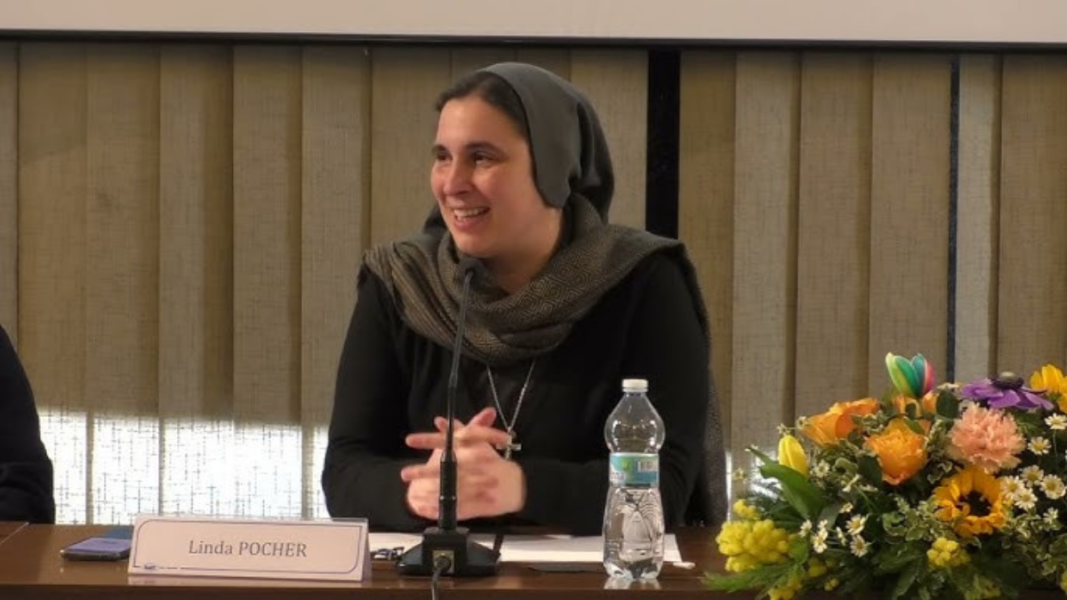
The Salesian theologian Sister Linda Pocher, appointed by Pope Francis to coordinate meetings with the cardinal advisors to “demasculinize the Church,” criticized the new brake on female diaconate and stated that the resistance does not come from theology, but from cultural factors. In statements to La Repubblica, Pocher lamented that the decision arrived too quickly: “I expected them to take a little more time, because in my opinion, in this issue, the time factor will be decisive”.
However, the vision she proposes does not recognize the nature of the sacrament of holy orders nor the doctrinal continuity that the Church is obliged to safeguard.
Reducing the theological objection to a cultural conflict
Pocher states without nuance that the problem “is not theological, but cultural.” This assertion reveals her starting point: understanding the reservation of holy orders as a human construct, not as a reality received from Christ. Under this scheme, the Church should adapt its sacraments to contemporary expectations, because—according to her reading—the resistances do not come from revelation but from patriarchal structures.
But this thesis clashes with two centuries of recent magisterium, with the apostolic tradition, and with the understanding of the priesthood as a sacramental configuration with Christ, Spouse of the Church. If everything is cultural, then the Church would be free to reconfigure to its liking what Christ instituted.
Pocher proposes an argument that disfigures the mystery
The religious sister goes so far as to affirm that, if Jesus’s masculinity has no salvific relevance because He was also Jewish, then it should not matter for ordained ministry either. The argument, formulated this way, ignores that Christ’s historical identity does not function as a sacramental basis, whereas his spousal relationship with the Church does.
Equating being male with being Jewish is evidence that Pocher’s approach does not start from Christology or sacramentology, but from egalitarian categories foreign to the Gospel.
A confusing vision
The interview also includes her criticism of the document that, according to her, “dismisses” the experience of women who say they feel called to the diaconate. Pocher denounces that these women do not receive the same treatment as a male candidate for the priesthood.
“It is not considered appropriate for women something that is the normal form of discernment for a man: a man enters the seminary because he feels called, he feels the vocation.”
But vocation is not defined by a subjective experience, but by Christ’s call mediated by the Church. No personal desire—male or female—constitutes proof of sacramental vocation. At this point, the religious sister projects onto vocational discernment an emotive logic that does not correspond to the nature of the sacrament.
A diaconate that is emptied of content to make it accessible
Pocher emphasizes that, since the Second Vatican Council, there exists a diaconate conceived as “community service,” to which women should have access. This formulation confirms that her proposal would imply redefining the diaconate to unlink it from the priesthood, reducing it to a social function to make it theologically accessible.
«The Second Vatican Council reinstated the permanent diaconate, to which married men can also have access. If there exists a diaconate of this type, a service to the community, why couldn’t women have access?»
But the diaconate, even in its permanent form, is a sacrament of holy orders. It is not a redistributable pastoral task nor a functional role within the community. De-sacramentalizing it to justify its opening is a conceptual manipulation that betrays the Church’s constant teaching.
A theology built from examples foreign to the Church
Pocher claims that the Anglican experience demonstrates that allowing female clergy “does not alter the functioning of the community.” But this appeal is fragile: the Anglican Communion has been traversing deep doctrinal fractures for years precisely because it adopted sociological criteria to reform its ministries.
It cannot serve as a model for the Catholic Church one that has already relativized sacraments, morals, and apostolic authority and that has truly demonstrated profound fragmentation in Anglican unity.
A project of Church shaped by cultural pressure
The Salesian religious sister recognizes that progress in this area depends on the “time factor.” That is: not on theological arguments, but on a gradual cultural change that pushes the Church to accept what it rejects today. That vision conceives the deposit of faith as a system moldable by social currents.
“The challenge of the Synod is that we can overcome a problem when we reach sufficient convergence, which does not mean that one of the parties renounces, but that, through common research, possibilities begin to emerge that perhaps none of the parties initially expected. But this requires time, training in reciprocal listening without prejudices, without considering heretical what the other says, but simply another way of seeing things. This was the great revolution of Francis.”
The true challenge is not to “demasculinize” the Church
Linda Pocher represents a theological current that seeks to reinterpret the Church from modern cultural challenges: gender, equality, female participation, social justice. The interview in La Repubblica shows a growing trend: treating ordained ministry as a male power structure to which “doors should be opened.” But this secularized view does not take into account sacramental logic: the priest acts in persona Christi, not as a representative of a social group.