


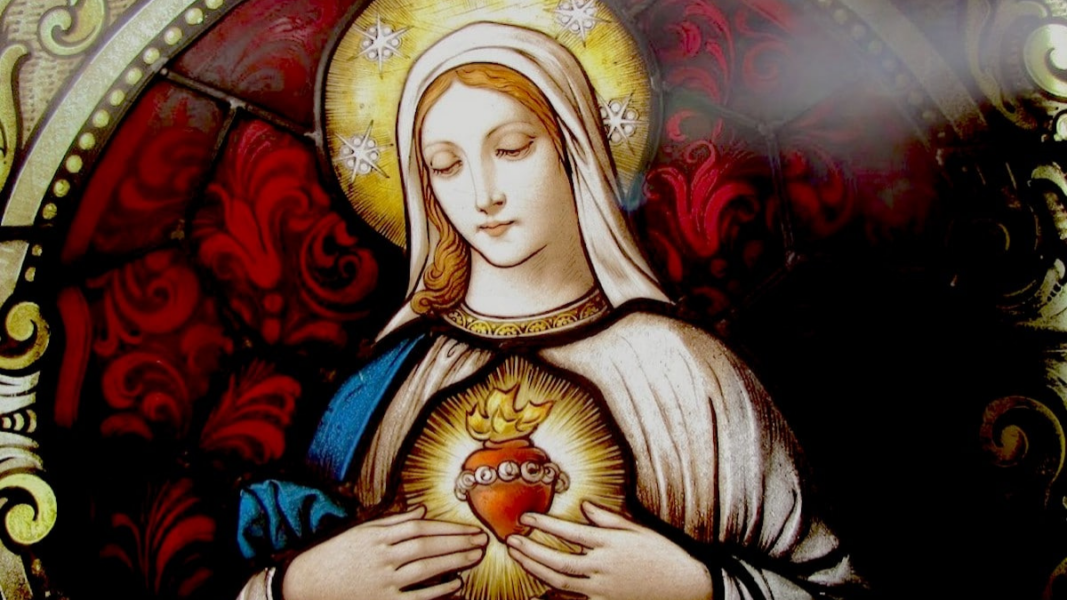
Talking about the Immaculate Heart of Mary is not repeating a sentimental devotion nor a pious appendix to doctrine. It is delving into one of the deepest mysteries of the Catholic faith: the unique participation of the Virgin in Christ’s redemptive work. Her Heart, preserved from sin from the first instant of her existence, beats in perfect harmony with that of the Savior and reveals—as saints and pontiffs have taught—the very essence of the co-redemption.
The Church has always recognized that the absolute purity of Mary’s Heart was not an isolated privilege, but the divine preparation for a singular mission: to be the Mother of the Redeemer and, with Him, collaborate in the restoration of the human race. Where sin entered through the disobedience of the first woman, grace re-enters through the unwavering obedience of the New Eve.
A Heart inseparable from that of Christ
Christian spirituality has often contemplated the indissoluble union between the two Hearts: that of Christ, which gives itself to the extreme, and that of Mary, which accompanies that giving with perfect availability. This union is not only affective, but theological: where Christ redeems, Mary accompanies; where the Savior offers Himself, the Mother cooperates.
That is why the tradition presents Mary’s Heart as the place where the work of Redemption visibly begins. There the “yes” that opens the way to the Incarnation is conceived, and there the fidelity that prepares the path to Calvary is safeguarded. The Immaculate Heart does not beat in parallel to that of Christ: it beats with Him, in a harmony that only grace can produce.
The co-redemptive mission: root, presence, and fruit
The idea of Mary as co-redeemer does not mean equating her action to that of Christ, but recognizing the truth that the Church has perceived since the early centuries: that God wanted to associate a new woman with the triumph of the new Adam.
Co-redemption manifests itself in three dimensions:
1. As root in the purity of the Immaculate
Mary participates in the redemptive work precisely because her Heart knows no shadow of sin. Her intact freedom can surrender without reservation to God’s plan. Purity is not pious sentimentalism: it is the ontological basis of her maternal mission.
2. As presence alongside the Redeemer
From Nazareth to Calvary, Mary shares the joys, labors, and sorrows of her Son. Her union with Christ is not aesthetic; it is real, painful, and fruitful. At the foot of the Cross, her spiritual motherhood becomes a gift for all humanity.
3. As fruit that extends in the Church
Co-redemption does not end at Golgotha. Mary continues to exercise her spiritual mission in favor of the faithful, leading souls toward the grace of Christ and protecting them in the struggle against sin. That is why the Church has seen in her Heart a safe refuge in times of confusion.
The saints understood it: whoever loves Christ cannot ignore the Heart of his Mother
The spiritual history of the Church is full of testimonies that confirm this truth: Mary’s singular participation in the Redemption is not a modern idea; it is a constant intuition.
Saints from diverse eras—pastors, theologians, martyrs, or mystics—have pointed out that no one has shared Christ’s pains as much as his Mother, and that her suffering united to that of the Son has immense spiritual value. It is not a matter of sentimentalism, but of contemplating how God wanted salvation to have a maternal face.
Consecrating oneself to the Immaculate Heart: a demand for times of spiritual combat
If Mary’s Heart is so united to that of Christ, the logical response of the Christian is to give oneself fully to Her. Consecration to the Immaculate Heart is not an optional or aesthetic act: it is a taking of position in the spiritual battle that characterizes our era.
To consecrate oneself means to place oneself under her maternal protection, to let her purity illuminate our interior life, and to participate in her docility before God’s will.
Modern apparitions—from Fatima onward—have only emphasized this need. In the face of the advance of error, moral confusion, and the lukewarmness of many baptized, the Lord offers the world a safe refuge: the Heart of his Mother. Where the serpent wounds, the Woman crushes its head.
Source: La Nuova Bussola Quotidiana