


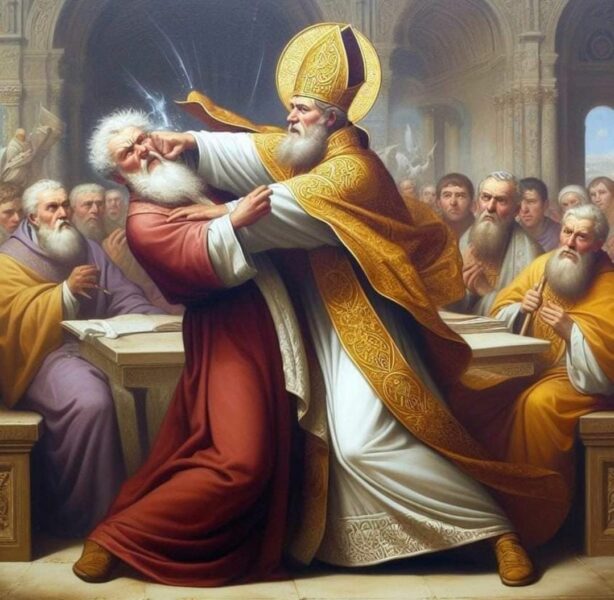
It’s Saturday, St. Nicholas, in our image of the day ‘arguing’ in Nicaea, and we have another impossible day ahead. The Holy See Press Office becomes, for the first time, a stage for two exceptional artists: Michael Bublé and Serena Autieri. The first, Canadian with more than 75 million albums sold worldwide, sang the «Ave Maria», which he will perform tomorrow at the Concert for the Poor in the Paul VI Hall, in the presence of the Pope. Autieri sang a snippet of the song «Quando nascette Ninno» in Neapolitan. The sixth Annual Concert with the Poor will be free and will feature Frisina, the Nova Opera Orchestra and the Diocesan Choir of Rome. Serena Autieri will be the host.
We start with new publications. The first complete book by Pope Leo XIV to be published in the United States will be released next year. “Peace be with you! My words to the Church and the world”, is scheduled for launch on February 26. It includes sermons and speeches he has given since his election in May. «Leo XIV. The History «, is the new book by Vaticanist Francesco Antonio Grana. In it he reconstructs the final part of Pope Francis’s pontificate and the subsequent Sede Vacante , one of the most unusual in recent history due to coinciding with a Jubilee. Prevost was present at the conclave from the first ballot and was elected on the fourth. Grana highlights how the new Pope inherited a complex legacy : twelve years of reforms, openings and internal tensions that deeply affected posing important challenges. The author, who knew Prevost before his appointment as cardinal, offers a personal and documented portrait of the future Leo XIV, intertwining biography , curial dynamics and the narrative of the last months of Pope Francis’s pontificate .
On Thursday, December 11, the unpublished book by Pope Benedict XVI, «God is the True Reality». Unpublished Homilies 2005-2017. Ordinary Time, will be presented. Present will be Father Federico Lombardi, president of the Joseph Ratzinger-Benedict XVI Foundation, and Lorenzo Fazzini, editorial director of the Libreria Editrice Vaticana, Archbishop Georg Gänswein, Apostolic Nuncio in Lithuania, Estonia and Latvia, former Personal Secretary to Benedict XVI, and Father Fabio Rosini, professor of Homiletics at the Pontifical University of the Holy Cross, will intervene. The event will be moderated by Silvia Guidi, journalist for L’Osservatore Romano. The book will be available in bookstores starting December 11. In the coming dates, two Masses in memory of Pope Benedict XVI will be celebrated in the Vatican Basilica. The first will be held on Tuesday, December 30, at 6:00 p.m. at the Chair Altar. The celebration will be presided over by Cardinal Gerhard Ludwig Müller, Emeritus Prefect of the Congregation for the Doctrine of the Faith, and will be in English. On December 31, the third anniversary of Benedict XVI’s death, a Holy Mass will be celebrated at 7:00 a.m. in the Vatican Grottoes, at the central altar. The celebration will be presided over by Cardinal Kurt Koch, Prefect of the Dicastery for Promoting the Unity of Christians, and will be in German.
It’s not a book, but it will undoubtedly be very interesting. American actor Chris Pratt is filming a documentary about the discovery of Peter’s tomb and will be set in the artistic and historical context of St. Peter’s Basilica and the Vatican Necropolis. «It is an extraordinary honor to collaborate with Pope Leo XIII and the Vatican on this project. The story of St. Peter is fundamental to the Christian faith, and I am deeply grateful for the trust and access they have given me to bring his legacy to the big screen.» The documentary, which will premiere in 2026, the year marking 400 years since the inauguration and dedication of the current St. Peter’s Basilica, which took place on November 18, 1626. The burial place of the Apostle in the Vatican necropolis was officially announced in 1950 by Pius XII, the Pope who ten years earlier had ordered excavations under the basilica. Subsequent investigations led Paul VI, in 1968, to announce to the world the discovery of the bones: «The relics of Peter have been identified in a way that we can consider convincing… We have reasons to believe that the few, but most sacred, mortal remains of the Prince of the Apostles have been located».
We enter today’s background topics. We’ve been saying it since the very first day of Pope Leo XIV’s pontificate, the issue of abuses in Chiclayo and their handling must be clarified satisfactorily for all parties as soon as possible. The risk is that the tangle keeps getting knotted and growing. Survivors of sexual abuse by clergy held a press conference on Thursday, December 4, 2025, to release new evidence showing that Pope Leo XIV exercised his new papal authority to avoid testifying about his involvement in covering up child sexual abuse in Peru. This evidence included internal Vatican documents, emails from Pope Leo, and recordings of meetings with church officials discussing the sexual abuse cases reported by Ana María Quispe Díaz and two other victims from the Diocese of Chiclayo in Peru. Quispe previously traveled to Chicago in July for a press conference. Her full statement on recent updates to her case can be found here.
Many articles on the ‘female diaconate’. In Pope Francis’s pontificate his government has always been structured in two parallel tracks: one official and one unofficial. On the female diaconate he had wanted the commission to examine a decades-long debate, putting it in direct contact with him and removing it from all mediation. He fueled the debate within the now-defunct C9 , bringing figures to the Council who could guide the discussion and persuade that body toward certain sensitivities. Pope Francis brought Sister Linda Pocher to the Vatican. Like Alessandra Smerilli, she did not particularly enjoy convent life, preferring to frequent salons, publishing houses and influential circles, constantly seeking support or favor. Pope Francis had her speak, along with other women, before the cardinals during the Council meetings dedicated to the role of women in the Church . However, she was a nun who offered no theological reflection, only random considerations.
A few days after his election, Leo XIV informed his collaborators that the members of the Council of Nine could consider themselves free to continue their activities as they saw fit, since he would never convene the C9. Leo XIV wanted to make it very clear that the Roman Curia had to be governed with the support of cardinals from all over the world; all , not nine. In this way, the government of the Church went from «Nine, nine, nine!» to «All, all, all!». On the issue of the «female diaconate» there are always bishops and cardinals willing to intervene to suppress any priest with the unfortunate idea of doing something authentically Catholic or truly useful for his faithful and young people , these same pastors seem to disappear when it comes to nuns who make statements contrary to doctrine. In the current Church, these figures with the right support seem able to do whatever they want, and even bishops willing to intervene regularly face power games and internal connections that are very difficult to decipher.
Sister Linda Pocher adorns herself in La Repubblica: «I am increasingly convinced that it is a cultural rather than theological problem», adding that ordination reserved for men would be «the last bastion of gender difference» and that behind the ecclesial resistance hides the idea that «Jesus saved humanity by being a man». These notions do not find support either in the broader historical-theological study or in the Summary of the Study Commission on the Female Diaconate , published yesterday, December 4, or in the Document «Diaconate: Evolutions and Perspectives» . The statements of the nun, which not only seem anti-Catholic , but also offer readers of that newspaper —already widely aligned— a summary completely distorted and false of the matter . The words of the Salesian reveal a sociological interpretation of the problem that finds no support in the documents. The Commission insists repeatedly that the decision «must be taken at the doctrinal level» and that historical research, while useful, offers no definitive certainties.
The International Theological Commission, already in 2002-2003, had affirmed that the so-called ancient female diaconate was never understood as equivalent to the male diaconate , nor did it have a sacramental character. «The female diaconate was conceived as a ministry sui generis , not in the line of the diaconate conferred on men». It is misleading to deduce , as Pocher does, that the existence of the permanent diaconate open to married men automatically creates space for a similar opening to women, this does not correspond to the Catholic vision of the sacrament. The fact that married men can be ordained is not a sign of «cultural flexibility», but rather a disciplinary option that does not affect the sacramental nature of the Orders. Equating an ecclesiastical discipline with the theological question of the subject of the Orders confuses different levels and risks generating erroneous conclusions. The sacramental structure cannot adapt to cultural dynamics without losing its theological identity .
Sister Pocher complains that the Commission did not value the testimony of women who expressed a strong «feeling» of having been called: «What is a normal discernment for a man entering the seminary because he feels a vocation, is not considered appropriate for a woman». The official text observes that the sacrament of Orders does not derive from a right or self-perception , and that a «vocational feeling» cannot constitute a sufficient criterion. It is false to present the synodal process as a dynamic univocally oriented toward reform. The Synod revealed strong divisions and, in several aspects, an explicit rejection . The overall picture, therefore, shows that the problem is not cultural or sociological, but theological . The fact that a nun goes to the extreme of lying to support her peculiar ideas that have nothing Catholic about them should require the intervention of her Superior General . But today, as we well know, we find ourselves in a completely upside-down world , in which what once seemed obvious no longer seems to scandalize anyone.
Another Study Group, Number Nine, makes its presence known. It is one of the working groups following the Synod Assembly and has published a provisional report in which it openly advocates for a paradigm shift in the treatment of doctrinal, pastoral and ethical issues. The group is chaired by Castillo Mattasoglio from Lima, and considers a transformation of thought and action necessary, insisting that truth and love (understanding «love» as adaptation to situations) are interconnected and cannot be treated as separate spheres. According to the study group, the old way of thinking is discarded as rigid and dogmatic and what is needed is pastoralness, understood as conformity. Alongside the Word of God, the subjectivity of the other must always be placed, and those who hold authority must not define the truth, but listen and accompany, paying attention to the cultural context, emotions and resistances. The result? No to universal solutions or objective truths. What is needed are reference criteria for discernment, especially on emerging issues like homosexuality and violence against women. The dogma is not formally denied, but evaded in the name of adaptation to the situation and the truth itself ceases to be an objective fact must adapt to pastoral care. For synodal moral theology, there are no immutable truths it is the triumph of relativism.
We continue with many news about the case and we have a new lead in the Rome prosecutor’s investigation into the disappearance of Emanuela Orlandi, which occurred on June 22, 1983. «The involvement of Emanuela Orlandi’s uncle is indicated by the Rome prosecutor’s office as an investigation hypothesis, but not the only one, that implicates him in the disappearance of his niece». There is an order for a search, at a good hour, that was executed in April 2024. The Carabinieri of the Investigation Unit of the Rome provincial command searched the house and reached the Meneguzzi villa in Torano, province of Rieti, just under a hundred kilometers from the capital. In the order, the magistrates clarify that this is not the only hypothesis under consideration. This step certifies the existence of multiple investigation leads, developed in parallel. But who is Meneguzzi? Emanuela’s uncle was a central figure in the negotiations with the alleged kidnappers, who, in the months following the disappearance of the Vatican citizen, called the Vatican residence of Ercole Orlandi, the girl’s father and former employee of the Prefecture of the Pontifical Household, deceased in 2004.
Father Spadaro speaks about Pasolini’s «The Gospel According to Matthew». A dialogue on the connection between cinema, spirituality and personal memory: the conference «The Immediate Sacred. The Gospel According to Pasolini» between master Martin Scorsese and Father Antonio Spadaro. «That Gospel was a provocation, so I was sure he would accept, as he finally did. Pasolini was impressed by the wild and prophetic fury of Jesus, which combines meekness and a terrible freedom.» «Rome is the natural meeting point of this conversation. Pasolini linked his most radical expressive language to the city: the Rome of his suburbs, his faces, his bodies. Scorsese, every time he comes here, recognizes in this city a place of cinematic and spiritual memory. And Rome inevitably evokes the evangelical narrative. Presenting a dialogue here on the Gospel, filmed by a layman like Pasolini and reimagined by a director like Scorsese, means making it resonate in its most natural symbolic space, in a city marked by the stratification of faith and art.»
Yesterday, December 5, the episcopal ordination of Reverend Francis Li Jianlin, of the Xinxiang clergy, took place, the Pope appointed him bishop of the Apostolic Prefecture of Xinxiang (Henan province, China) on August 11, 2025, after approving his candidacy within the framework of the Provisional Agreement between the Holy See and the People’s Republic of China.
And we end by recommending the interesting, complete and documented summary of Leo XIV’s first trip that The Wanderer offers us in The Pope Leo XIV’s Trip to the Levant. Impressions. Tosatti picks up an interesting aspect: the request that states that «Catholics too want to have the same privilege of attention and affection, given with an ecumenical spirit to others.» «How sad to note this ‘understandable’ attention toward others belonging to other religions, while ‘his beloved children’, Catholics, apostolic and Roman, do not deserve so much the desired attention. Attention expected and, in my opinion, due before other attentions since Leo XIV’s predecessor exalted Protestants and pagans, but intimidated, punished, persecuted, suspended, commissioned many Catholics and many Catholic movements accused of being too ‘traditionalist, even too ‘Marian».»